Bangkok private transfer vs taxi compared: cost, booking, safety, and luggage. Which wins for families, solo travelers, and seniors at the airport?
Options at a Glance
Arriving at Suvarnabhumi or Don Mueang, you've got three realistic ways to reach your hotel: a pre-booked private transfer, a metered taxi from the official rank, or a Grab booked through the app. Each works. None is a scam or a trap, despite what some overly cautious blog posts suggest. The real question is which trade-offs you're willing to accept.
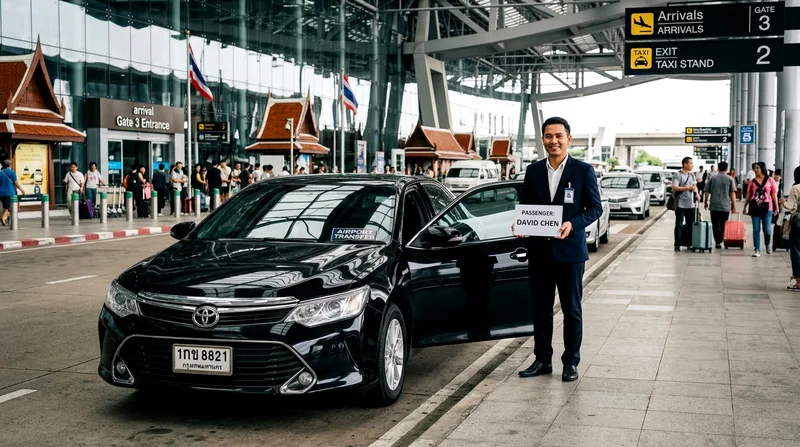
A private transfer means a fixed price agreed before you land, a driver holding a sign with your name, and a vehicle — often a Toyota Alphard or similar minivan for groups — waiting regardless of your flight's delay. A metered taxi means queuing at the designated rank, paying by the meter plus a small airport surcharge, and accepting whatever traffic conditions exist that hour. Grab sits in between: app-based booking, upfront fare estimates, but still subject to surge pricing and driver availability at peak arrival times.
I'd avoid the information you'll find on some TripAdvisor threads and Facebook travel groups treating this as a moral choice — "real travelers take taxis" versus "private transfers are for tourists who get ripped off." Both camps overstate their case. The honest answer depends on your luggage, your patience, and how much a predictable price matters to you after a 12-hour flight.
A private transfer costs more but removes nearly every variable; taxis and Grab cost less but ask you to tolerate traffic, queues, and occasional driver friction.
Bangkok private transfer vs taxi vs Grab: cost, booking, and convenience compared
| Option | Typical cost (to central Bangkok) | Booking method | Wait time on arrival | Best for |
|---|---|---|---|---|
| Private transfer | ฿800–1,500+ | Online, in advance | None — driver waits | Families, seniors, late arrivals |
| Metered taxi | ฿300–500 | Queue at rank | 10–30 min | Budget-conscious, light luggage |
| Grab | ฿350–600 (surge varies) | App, on arrival | 10–20 min | Solo travelers, app users |
| Airport Rail Link + taxi/BTS | ฿45–100 (rail) + onward fare | In-person, no booking | Minimal, but transfers add time | Backpackers, no heavy bags |
Figures are general ranges; actual fares shift with traffic, tolls, time of day, and fuel surcharges, so confirm current pricing before you book.
Private pre-booked transfer
You book online before departure, pay a fixed rate (commonly somewhere between ฿800 and ฿1,500 for a sedan into central Bangkok, more for a minivan or long-distance drop like Hua Hin), and a driver meets you inside the arrivals hall holding a name sign. No negotiation, no meter anxiety, no language barrier at the curb. The driver tracks your flight, so a three-hour delay doesn't cost you a no-show fee. This matters more than people expect — Bangkok's two airports are busy, and immigration queues alone can run 45 minutes during peak season.
Metered taxi and Grab
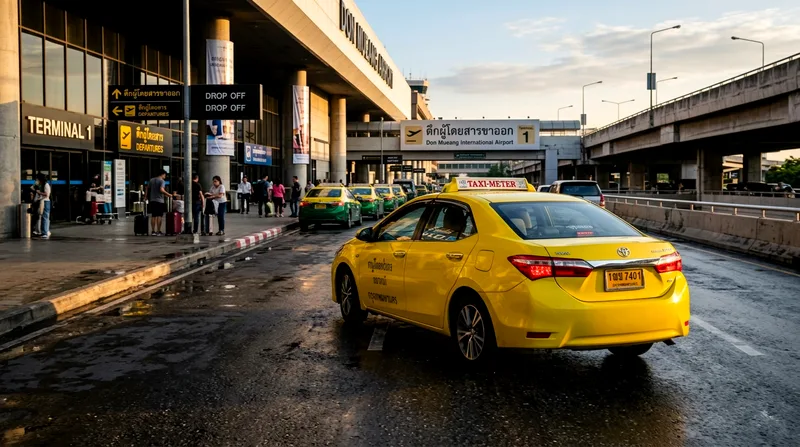
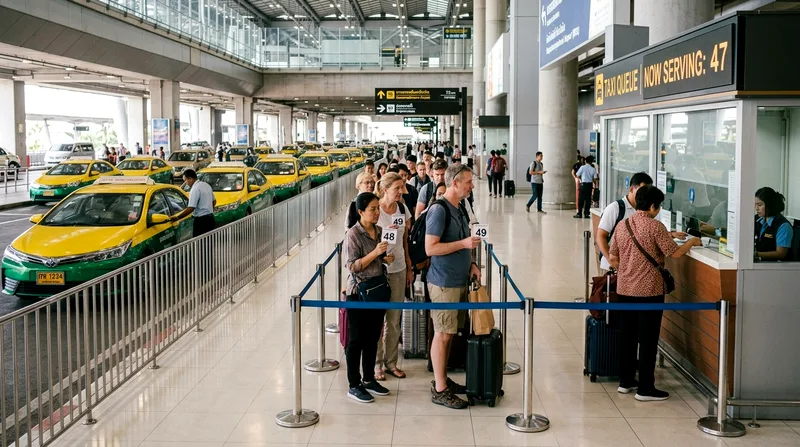
Official taxis queue at a marked rank — follow the ticket-dispensing machine system at Suvarnabhumi's Level 1, not the drivers who approach you inside the terminal offering a "special price." That approach is almost always a markup. A legitimate metered ride into central Bangkok typically runs ฿300–฿500 including the ฿50 airport surcharge and tollway fees, depending on destination and traffic. Grab works similarly but through the app, with an upfront estimate before you confirm — useful if you don't speak Thai and want to avoid the queue system entirely. Uber no longer operates independently in Thailand; it merged into Grab years ago, so don't bother downloading it.
Cost Comparison: Fixed vs Metered
The private transfer costs more on paper, and I won't pretend otherwise. You're paying roughly double a metered taxi fare for the same route into central Bangkok. But "cost" isn't just the number on the receipt — it's also what you're protected against. A fixed-price transfer means no surprise toll charges stacking up, no meter running during a 40-minute jam on the expressway, and no awkward moment where a driver claims the meter is broken and quotes double.
Upfront pricing breakdown
A metered taxi fare into areas like Sukhumvit or Silom typically lands between ฿300 and ฿500, built from the base meter rate plus two tollway charges (roughly ฿25–75 each if you take the expressway) and the flat ฿50 airport pickup surcharge. A private transfer quotes one number upfront — commonly ฿800–1,200 for a sedan, climbing toward ฿1,500–2,000 for an Alphard-class minivan fitting four to six with luggage. Hotels like the Siam Kempinski often list their own transfer rates for guests, usually priced close to or slightly above independent operators, so it's worth comparing before defaulting to the hotel's option.
Peak and off-peak variations
Grab fares surge during rain, rush hour (roughly 4–8pm on weekdays), and major holidays — sometimes 1.5x to 2x the base estimate. Metered taxis don't surge in price, but they do sit in the same traffic, so your fare climbs simply because the meter keeps ticking during a standstill on the Si Rat Expressway. Private transfers are immune to surge pricing by design, though some operators add a modest night surcharge (typically after 11pm or before 5am) baked into the original quote rather than sprung on you later.
Convenience and Booking Process
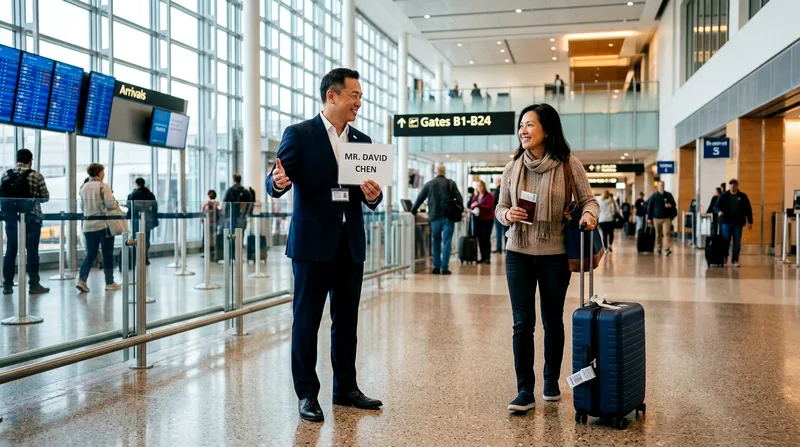
Booking convenience is where the private transfer earns its premium. You reserve it days or weeks ahead, receive a confirmation with driver contact details, and walk out of arrivals already knowing your ride exists. Compare that to the taxi rank experience: find the right queue (not the touts near the doors), take a numbered ticket, wait your turn, then communicate your destination — ideally with the address written in Thai, since not every driver reads English addresses fluently, especially outside the main tourist zones.
Advance booking vs on-arrival
Booking in advance suits anyone landing at an odd hour — a 1am arrival from a European long-haul flight, for instance, when taxi queues thin out but so does your patience. Grab can be booked the moment you land and connect to WiFi, which works fine if your phone has a local SIM or eSIM ready; without data, you're stuck using airport WiFi, which is serviceable but not always fast enough to load the app reliably.
Wait times and reliability
Taxi queues at Suvarnabhumi typically move within 10–20 minutes outside peak hours, longer during afternoon arrival banks when multiple long-haul flights land together. Grab wait times run similar, sometimes longer if drivers are reluctant to enter the airport's designated pickup zones (a known friction point discussed often on Reddit's Thailand threads). Private transfers eliminate this entirely — your driver tracks the flight number and adjusts, a genuine advantage after a delayed connection through somewhere like Kuala Lumpur or Hong Kong.
Safety, Comfort, and Luggage
Bangkok taxis are generally safe. Thousands of visitors use them daily without incident, and companies like Bangkok Taxi 24 maintain fleets with reasonable upkeep. The real risks are minor: a driver who doesn't know a newer condo development, occasional reluctance to use the meter (illegal, but it happens, mostly with drivers soliciting inside the terminal rather than at the official rank), or a vehicle that's seen better decades. None of this is dangerous — it's just friction.
Vehicle quality and space
Standard taxis are compact sedans — fine for one or two people with carry-on bags, cramped for a family of four with two large suitcases and a stroller. Private transfer operators let you select vehicle size when booking, so a Toyota Alphard or similar minivan with real trunk space becomes an option rather than a gamble. If you're traveling with golf clubs, car seats, or oversized luggage, this alone justifies the higher price.
Language and accessibility
Many taxi drivers speak functional English for directions but not much beyond that. Grab's app sidesteps this since the destination is already set digitally. Private transfer drivers booked through English-language platforms are more consistently able to handle questions, provide a bottled water, or adjust the route if your hotel address is unclear — a small but real comfort for seniors or anyone uneasy about communication barriers.
Who Should Choose Which Option
There's no universally correct answer here, and I'm skeptical of articles that pretend otherwise. The right choice depends on who's traveling and what they're optimizing for — money, time, or peace of mind.
Families and groups
Families with children, strollers, and multiple suitcases should lean toward a private transfer. The math is simple: two taxis (because one sedan won't fit everyone and everything) often costs nearly the same as one minivan transfer, with far more hassle. A tired toddler at midnight doesn't benefit from a 20-minute queue and a cramped back seat.
Solo travelers and seniors
Solo travelers comfortable with queues and light on luggage do fine with Grab or a metered taxi — it's cheaper and barely slower. Seniors are a different case: not because taxis are unsafe, but because navigating an unfamiliar queue system after a long flight is genuinely tiring. A private transfer's name-sign pickup removes that entire step, which is worth the extra ฿500–800 for many older travelers.
Final Verdict
If I'm booking for a family of four landing after a 14-hour flight, I'm paying the ฿1,200–1,800 for a private transfer without hesitation — the certainty is worth more than the savings. If I'm a solo traveler with a backpack and some patience, I'm taking the Airport Rail Link into town or hailing a metered taxi, pocketing the difference for pad thai and a Chao Phraya river cruise later that week. Couples somewhere in between should weigh their luggage and arrival time — a 3am landing tips the scale toward pre-booked, a 2pm arrival with carry-on bags only tips it toward Grab.
This isn't unique to Bangkok, either. The same logic applies if you're comparing transfer options into Phuket or Chiang Mai, where distances from the airport to your hotel can be longer and traffic less predictable than central Bangkok's grid. Pattaya transfers face similar surge-pricing quirks around holiday weekends. The pattern holds: fixed price buys certainty, metered and app-based rides buy flexibility and savings.
Frequently asked questions
Is a private transfer cheaper than a taxi from Bangkok airport?
No — a private transfer typically costs ฿800–1,500 or more versus ฿300–500 for a metered taxi into central Bangkok. You're paying a premium for a fixed price, guaranteed vehicle, and no queue, not for a cheaper ride.
Should I book a private transfer in advance or use Grab?
Book in advance if you're arriving late at night, traveling with a group, or landing after a long-haul flight with likely delays. Use Grab if you have local data access, light luggage, and don't mind occasional surge pricing during rain or rush hour.
What is the best airport transfer option for families with luggage?
A private transfer with a minivan like a Toyota Alphard is the practical choice for families with strollers, car seats, or more than two large suitcases. Two separate taxis often cost nearly as much and add significant hassle at the curb.
Are Bangkok taxis safe and reliable for solo travelers?
Yes, generally. Stick to the official taxi rank queue inside the terminal rather than drivers soliciting near the doors, insist on the meter, and you'll have a safe, straightforward ride. The main risks are minor fare disputes, not personal safety.
Is a pre-booked transfer worth it from Bangkok airport?
It's worth it if you value certainty over savings — no queue, no language barrier, fixed price regardless of traffic or flight delays. It's not worth it if you're traveling light, comfortable with queues, and want to save ฿500–1,000 per ride.