Compare guided Bangkok tuk-tuk tours vs. independent rides. Pricing ranges, booking platforms, safety tips, and the best temple and food routes.
Who Each Tuk-Tuk Tour Type Suits
Not every traveler wants the same thing from a Bangkok tuk-tuk tour. Some want a structured two-hour loop past the big landmarks with a narrating guide; others want a driver who'll go wherever they point and wait while they eat. Figuring out which camp you're in before you book saves money and disappointment.
Group tours work well if this is your first trip to Bangkok and you want orientation more than depth — a sense of where things are before you come back on foot or by boat. Private tours suit couples, families with kids who tire easily, and anyone with dietary restrictions or mobility limits who needs a route that can flex. Senior travelers in particular tend to do better with private charters, since group tours rarely pause long enough at each stop and the open-air seating can feel exposed to sun or rain for an uninterrupted two hours.
Group tours for first-time visitors
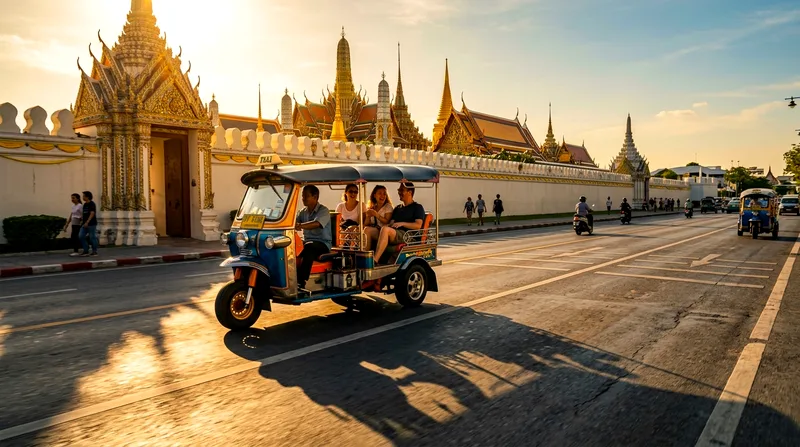
A typical group tuk-tuk tour runs two to three hours, moves in a small convoy of three to six vehicles, and follows a fixed route — usually Old Town temples plus one food stop. Prices on platforms like GetYourGuide or Viator commonly sit in the 800–1,800 THB per person range for a shared tour, though always check the live listing since inclusions vary. The upside is cost-sharing and a built-in guide who handles navigation and timing. The downside: you're on someone else's schedule, photo stops get rushed, and if one tuk-tuk in the convoy breaks down (it happens — these are decades-old three-wheelers) the whole group waits.
Private tours for flexibility and customization
Private tuk-tuk tours cost more — often 1,500–3,500 THB for the vehicle rather than per person, which actually makes them better value for families of three or four splitting the cost. You set the pace, swap stops, and can ask the driver to linger at Pak Khlong Talat flower market or skip a temple you've already seen. The trade-off is that you need to vet the operator more carefully, since a private booking with an unreviewed driver is exactly where fixed-route scams (unscheduled gem-shop stops, suit-shop detours) tend to creep in. Stick to operators with visible reviews on a platform like KKDay rather than a driver's business card handed to you on the street.
Guided Tours vs. Independent Rides
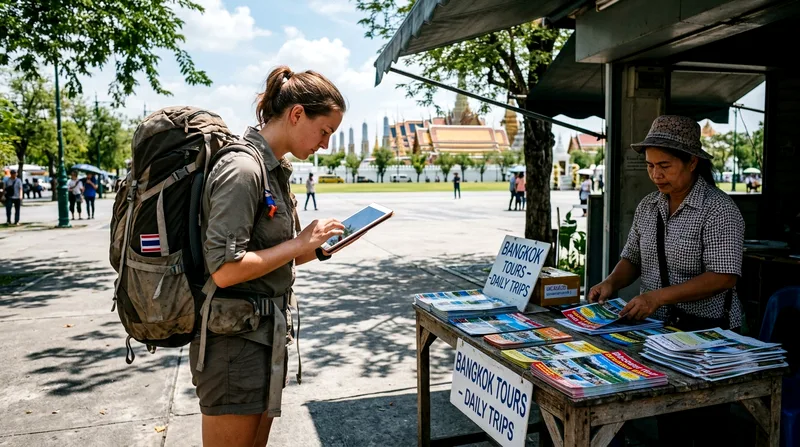
This is the decision that matters most, more than which temple circuit you pick. An independent ride means flagging a tuk-tuk on the street, agreeing a price by hand gesture or broken English, and hoping the driver takes you where you asked. A guided tour means a pre-booked vehicle, a confirmed itinerary, and — usually — a fixed price paid in advance or to a company rather than the driver directly.
Independent tuk-tuks are cheaper on paper for a single short hop, maybe 60–150 THB for a ten-minute ride within a neighborhood. But Bangkok's famous tuk-tuk scam still operates in tourist-dense areas near the Grand Palace and Khao San Road: a driver offers an absurdly cheap city tour, then steers you to a jewelry or tailor shop where he earns a commission for the stop, sometimes three or four such stops in a row. It's not dangerous, just a waste of an afternoon, and it's the single biggest complaint in traveler forums about Bangkok tuk-tuks.
Guided and private tuk-tuk tours cost more than flagging one down independently, but they trade that premium for route reliability and far less scam risk.
Bangkok tuk-tuk tour options compared: guided, private, and independent rides
| Option | Typical duration | Typical cost | Best for | Scam risk |
|---|---|---|---|---|
| Group guided tour | 2–3 hours | Low-to-mid range, per person | First-time visitors, solo travelers | Low |
| Private guided tour | 2–4 hours | Mid-to-high range, per vehicle | Families, couples, seniors | Low |
| Night tuk-tuk tour | 2–3 hours | Mid range, per person or vehicle | Couples, photography fans | Low |
| Independent street ride | 10–40 minutes | Low, negotiated on the spot | Short point-to-point hops | Higher |
Figures are typical ranges based on commonly published listings; always check current prices and reviews on the booking platform before confirming.
Safety and driver reliability comparison
Guided tours booked through an established platform list the driver or company, show recent reviews, and generally include some accountability if something goes wrong — a bad guide gets flagged publicly. Flagging an independent tuk-tuk gives you none of that; you're trusting a verbal fare agreement with a stranger. Physically, both options carry the same real risk: tuk-tuks have no seatbelts, no doors, and Bangkok traffic is genuinely chaotic, so neither option is "safe" in the way a metered taxi with aircon is. If you're traveling with young children or you're uneasy in open-air vehicles weaving through traffic, consider this a novelty ride rather than daily transport either way.
Route quality and local knowledge
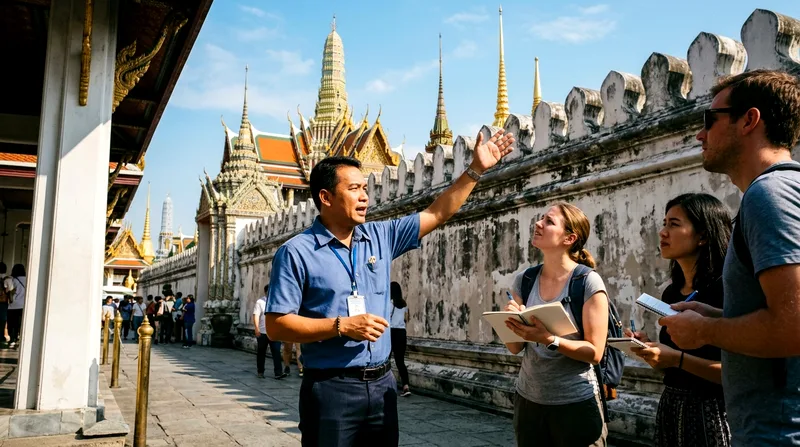
A guided driver who does this route daily usually times it around traffic and temple closing hours, and many tours fold in a stop a solo rider wouldn't find — a specific noodle stall near Chinatown, a quiet sidestreet view of Wat Arun across the river at sunset. An independent ride depends entirely on whether you can direct the driver yourself, which is hard if you don't know Bangkok's one-way system or which temples require modest dress. For a single short transfer between two known points, independent is fine and often faster. For anything resembling a "tour," guided wins on route quality almost every time.
Popular Tour Routes and Landmarks
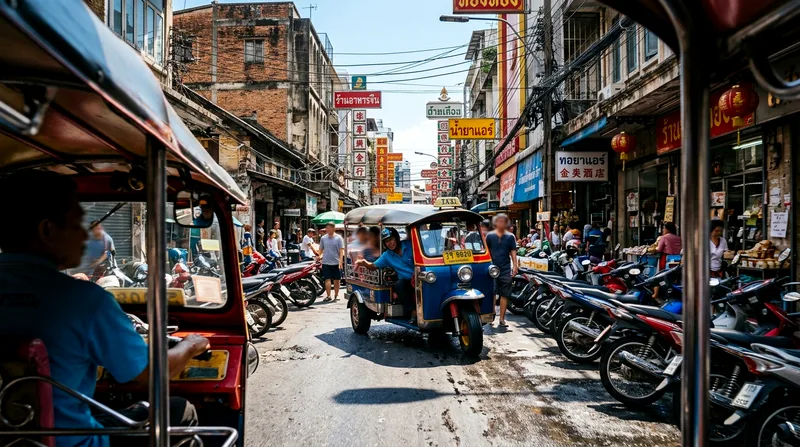
Most Bangkok tuk-tuk tours draw from the same pool of landmarks, just packaged differently depending on daytime or night timing. Knowing the standard route helps you spot which operators are padding the itinerary with filler stops versus genuinely useful ones.
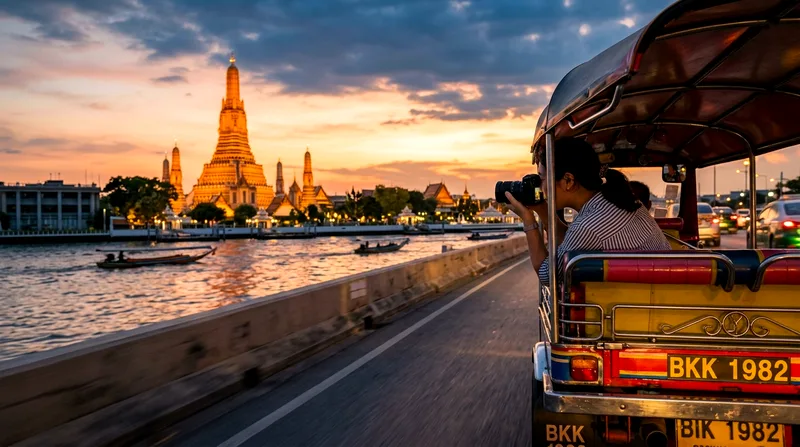
Temple circuits and Old Town routes
The core daytime loop covers the Grand Palace exterior, Wat Pho (home of the reclining Buddha, and one of the few temples where a tuk-tuk can drop you right at the entrance), and a river crossing or photo stop near Wat Arun across the Chao Phraya. Some itineraries add the Giant Swing (Sao Ching Cha) near Wat Suthat, a striking red teak structure that most self-guided visitors skip entirely since it's a quick photo stop rather than an attraction you enter. Note that tuk-tuks can't actually enter the Grand Palace grounds — you'll be dropped nearby and walk in, so factor in the palace's strict dress code (covered shoulders and knees, closed-toe shoes) regardless of how you arrive.
Chinatown and street food experiences
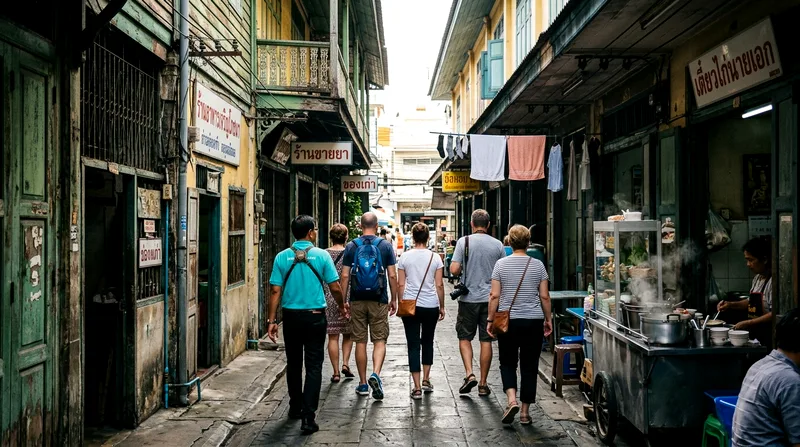
Evening and night tuk-tuk tours shift the focus to Chinatown (Yaowarat), where neon signage and food stalls make for a livelier ride than the daytime temple loop. A common format includes three or four food stops — think boat noodles, mango sticky rice, or grilled seafood — plus a slow pass through Yaowarat Road once the lights come on. Some routes also swing by Pak Khlong Talat, Bangkok's 24-hour flower market, which is more atmospheric after dark when wholesalers are unloading fresh orchids and marigolds. If you have specific dietary needs, ask before booking whether food stops are included in the price or paid separately — this varies a lot between listings.
What to Look for When Booking
Treat a tuk-tuk tour booking the same way you'd treat any guided activity — check what's actually included before assuming.
Inclusions, group size, and cancellation policies
Check whether hotel pickup is included — many Bangkok tuk-tuk tours offer it within central areas like Sukhumvit, Silom, or the Old Town, but charge extra or exclude it for hotels further out near the airport expressways. Confirm whether food and drink tastings are bundled into the price or an optional add-on, since this is the most common source of post-booking surprise fees. Look at group size too: a tour capped at six to eight guests across two tuk-tuks moves faster and feels less like a tour bus experience than one cramming fifteen people into a convoy. Free cancellation up to 24 hours before departure is standard on major platforms — avoid anything that only offers non-refundable booking, especially given Bangkok's unpredictable afternoon downpours between roughly May and October.
Booking platforms and operator reviews
GetYourGuide, Viator, and KKDay all list multiple Bangkok tuk-tuk tour operators with recent reviews, star ratings, and clear cancellation terms — this is generally a safer starting point than booking through a hotel concierge or a street tout, where accountability is harder to trace. Read the most recent reviews rather than the overall score, since a route or driver can change over a matter of months. Watch for reviews that mention unscheduled shop stops — that's the clearest red flag that a "tour" is actually a commission-driven detour dressed up as sightseeing, and it does still happen even with listed operators occasionally.
Best Time to Book and Go
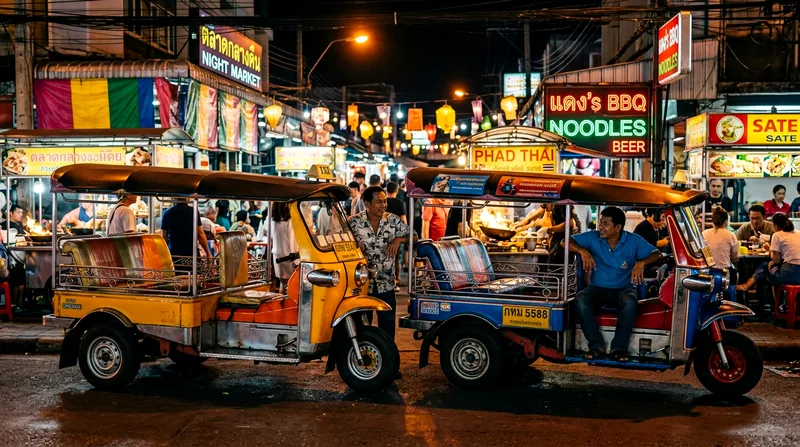
Timing affects both comfort and availability more than most visitors expect, particularly in an open-air vehicle with no climate control.
Seasonal considerations and weather
Bangkok's cool season, roughly November through February, is the most comfortable window for an open-air tuk-tuk ride — daytime temperatures hover in the low-to-mid 30s Celsius rather than the high-30s heat of April, which is brutal with no air conditioning and direct sun. The rainy season, May through October, brings sudden afternoon downpours; a night tuk-tuk tour is actually a reasonable workaround here since evenings are cooler and showers tend to clear by early evening, though you should still check the forecast and confirm the operator's rain policy (some pause tours, others provide ponchos and continue).
Advance booking vs. same-day availability
Popular night tuk-tuk tours and food-focused Chinatown routes can sell out a day or two ahead during peak season (December–January) or around Thai holidays like Songkran in April, so booking three to five days out gives you more choice of time slots. Private tours have more same-day flexibility since you're not waiting to fill a group quota — some operators on KKDay or GetYourGuide confirm private bookings within a few hours. If you're flexible on dates, weekday evenings tend to have more open slots and lighter traffic than Friday or Saturday nights, when Bangkok's roads slow considerably.
Frequently asked questions
What is included in a Bangkok tuk-tuk tour?
Most guided tours include the vehicle, driver, and a fixed route past landmarks like the Grand Palace exterior, Wat Pho, and Wat Arun viewpoints, plus hotel pickup in central districts. Food tastings, entrance fees to temples, and bottled water are sometimes included and sometimes extra — always check the specific listing rather than assuming, since this varies significantly between operators.
How much does a guided tuk-tuk tour cost?
Shared group tours commonly fall in the 800–1,800 THB per person range, while private tours (priced per vehicle rather than per person) often run 1,500–3,500 THB for two to four hours. These are typical published ranges, not fixed prices — check current listings on GetYourGuide, Viator, or KKDay before booking, since inclusions and season affect cost.
Are night tuk-tuk tours available in Bangkok?
Yes, night tuk-tuk tours are widely available and popular, usually running two to three hours through Chinatown's illuminated Yaowarat Road with multiple street food stops. They're often more comfortable than daytime tours since temperatures drop and the lighting makes for better photos, though traffic can be heavier on weekend evenings.
Is it safer to book a guided tour or flag down a tuk-tuk?
A booked guided tour is generally the safer choice for avoiding scams, since the operator, route, and price are confirmed in advance and tied to a reviewable platform. Flagging an independent tuk-tuk isn't dangerous in a crime sense, but it carries a higher risk of fare disputes and the classic gem-shop detour scam near tourist areas like Khao San Road.
What landmarks are typically visited on tuk-tuk tours?
Standard stops include the Grand Palace exterior, Wat Pho, a photo stop near Wat Arun across the river, and sometimes the Giant Swing near Wat Suthat. Night and food-focused tours shift toward Chinatown's Yaowarat Road and occasionally the Pak Khlong Talat flower market, which is especially active after dark.