Bangkok temple tour vs self-guided: compare costs, time, dress codes, and depth of experience at Wat Pho, Wat Arun, and the Grand Palace.
Options at a Glance
Bangkok's big three — Wat Pho, Wat Arun, and the Grand Palace with Wat Phra Kaew inside its walls — sit within a 20-minute walk or a short boat hop of each other along the Chao Phraya River. That proximity is exactly why the guided-versus-self-guided debate matters: you're not choosing between one temple or another, you're choosing how you want to experience a cluster of sites that almost everyone visits in a single outing.
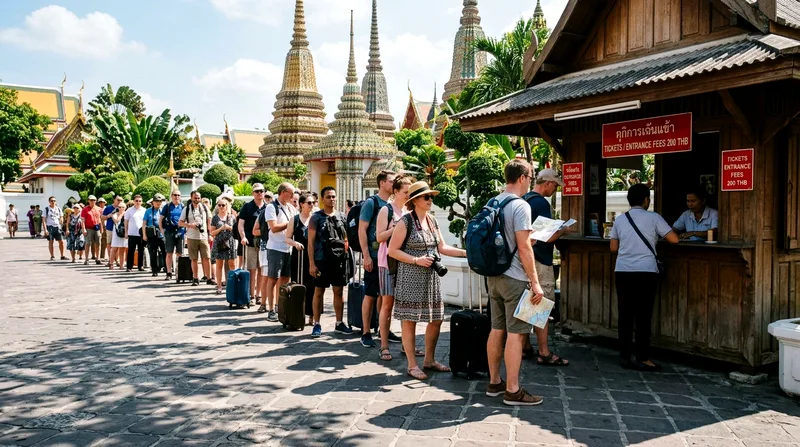
A guided tour, booked through platforms like Viator or GetYourGuide or directly with a hotel concierge, typically bundles transport, entry tickets, and a English-speaking guide into one block of three to five hours. Self-guided means buying your own BTS Skytrain or MRT ticket, walking or taking a riverboat to each site, and queuing for entry yourself.
Neither option is objectively better — they solve different problems. A guided tour solves the problem of not knowing what you're looking at. Self-guided solves the problem of not wanting to move at someone else's pace. Where many travelers go wrong is picking the format based on price alone, without weighing what they'd actually lose or gain.
What guided tours include
Most half-day Bangkok temple tours cover the Grand Palace, Wat Phra Kaew (the Temple of the Emerald Buddha), and Wat Pho, sometimes adding a boat crossing to Wat Arun. Expect hotel pickup or a meeting point, a guide carrying a laminate or tablet with historical images, and skip-the-line entry in some cases — though the Grand Palace's single ticket queue often can't be bypassed regardless of tour type. Group sizes range from 8 to 25 people depending on the operator; private tours exist but cost two to three times more. Transport is usually by air-conditioned van or minibus, which matters more than it sounds in April and May when outdoor temperatures regularly hit 35°C (95°F).
What self-guided requires
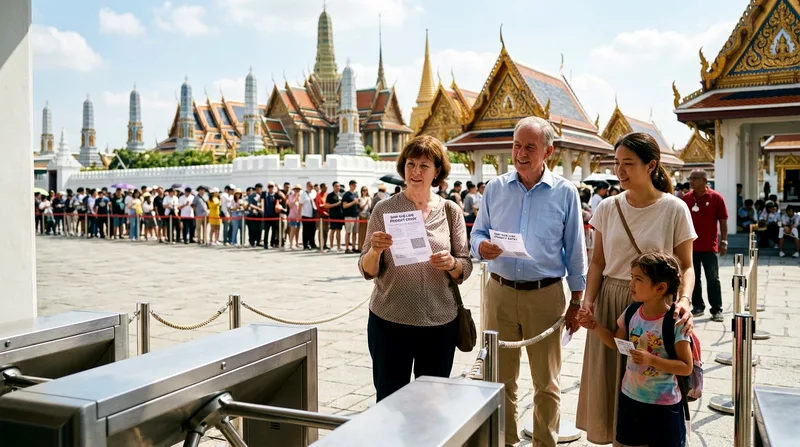
Doing it yourself means three separate logistics problems: getting there, getting in, and getting the context. Getting there is the easy part — MRT to Sanam Chai station puts you a 10-minute walk from the Grand Palace, and cross-river ferries (around 4-5 THB per crossing) connect the Tha Tien pier near Wat Pho to Wat Arun directly. Getting in requires buying tickets on-site (cash or card, no pre-booking needed for individuals at most temples) and passing a dress-code check — more on that below. Getting the context is the gap: without a guidebook, an audio app, or prior reading, you'll see beautiful buildings without knowing why the Emerald Buddha changes outfits three times a year or why Wat Arun is covered in broken Chinese porcelain.
Head-to-Head: Cost, Time, and Effort
Money and minutes are where the two approaches diverge most sharply, and it's worth being blunt about the trade-off rather than pretending one option is simply "better."
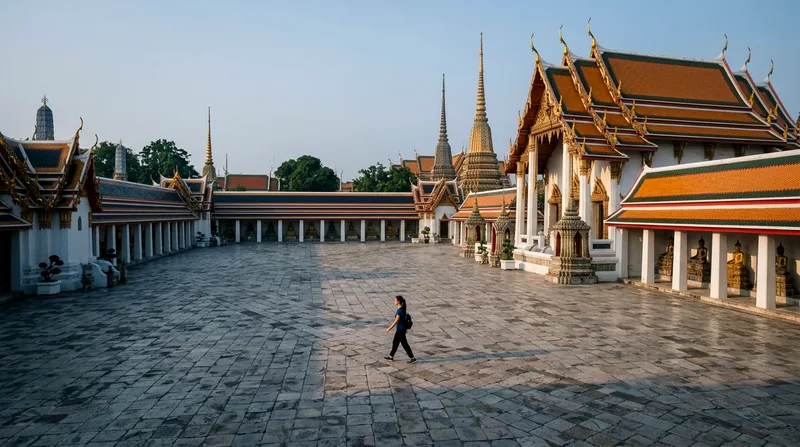
Self-guided temple visits typically cost less than half of a guided tour but demand more time and planning upfront.
Bangkok temple tour vs self-guided: cost, time, and effort compared
| Approach | Typical cost per person | Time needed | Planning effort | Best suited for |
|---|---|---|---|---|
| Guided half-day tour | Moderate-high (tour fee bundles entry + transport) | 3-5 hours fixed | Low — booked in advance | First-timers, history lovers, limited time |
| Self-guided by BTS/MRT + walking | Low (entry fees + transit fares only) | 4-6 hours flexible | Medium — route and hours to check | Budget travelers, solo explorers |
| Self-guided by river ferry | Low (entry fees + ferry fares, a few baht each crossing) | 4-7 hours flexible | Medium — pier locations to confirm | Couples, photographers, slower pace |
| Private guided tour | High (2-3x group tour price) | 3-6 hours, customizable | Low — but requires advance booking | Families, seniors, mobility-limited travelers |
| Hybrid (self-guided + single guided stop) | Moderate | 4-6 hours | Medium | Travelers wanting context without full group commitment |
Figures are typical ranges; exact prices vary by season, operator, and whether temples waive fees for certain visitors — check current prices when booking.
Budget breakdown
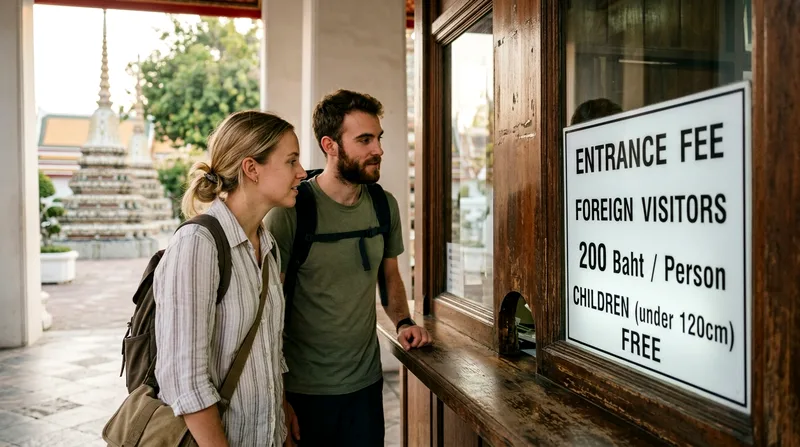
A guided half-day tour bundles entry fees, transport, and the guide's fee into one payment, which sounds efficient until you realize you're paying for convenience you might not need. Self-guided travelers pay the Grand Palace and Wat Phra Kaew entry fee directly (one combined ticket covers both), plus a separate smaller fee at Wat Pho, plus a token amount to climb and photograph Wat Arun. Add BTS/MRT fares (typically 16-44 THB per trip depending on distance) or ferry crossings (a few baht each), and the total self-guided cost usually lands at a fraction of the tour price. Where guided tours claw back value is in avoided mistakes — wrong queue, wrong entrance, wasted half-day — which for a first-timer can be worth real money in lost time.
Time investment and logistics
Guided tours move fast because they have to — groups have a schedule, and your guide isn't lingering at Wat Arun while you photograph the prang from six angles. Self-guided visits take longer in total but let you skip what bores you. A self-guided day can realistically cover all three major sites in 5-6 hours if you start by 8:30am, before the Grand Palace crowds and heat build up; starting after 11am extends everything by an hour or two as you wait out both lines and sun exposure. One real logistics trap: the Grand Palace closes its ticket counter in the afternoon on some days, and self-guided travelers who arrive late sometimes discover they've burned a Bangkok morning for nothing. Guided tours, having fixed slots, rarely make this mistake.
Experience Depth and Cultural Insights
This is where the two approaches genuinely feel like different trips, not just different price points.
Knowledge and storytelling
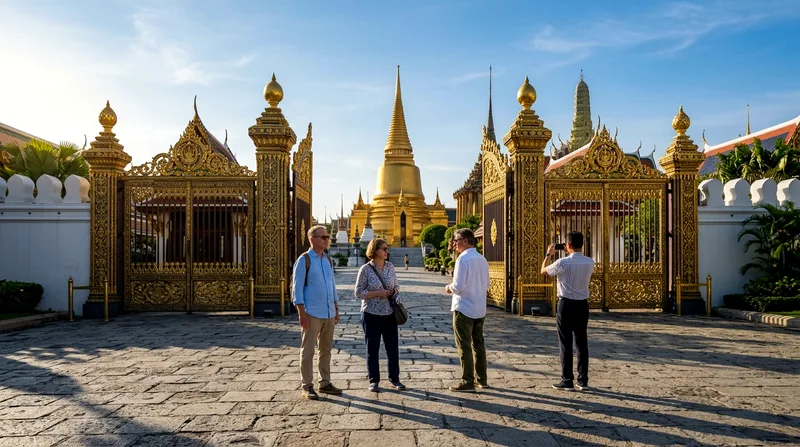
A decent guide turns the Grand Palace from a photogenic blur of gold and glass mosaic into a coherent story — why Rama I built it to mirror Ayutthaya's lost royal complex, why the Emerald Buddha is carved from jade rather than emerald, why certain murals depict the Ramakien epic rather than Buddhist scripture directly. That narrative layer is genuinely hard to replicate solo unless you've done homework beforehand or you're running an audio guide app mid-walk, which half the time loses signal in the palace's thick-walled galleries. I'd rate guided storytelling as the single strongest argument in favor of tours — but only at the Grand Palace and Wat Phra Kaew. At Wat Pho and Wat Arun, the architecture and giant reclining Buddha speak for themselves well enough that a guide's commentary adds less.
Pace and flexibility
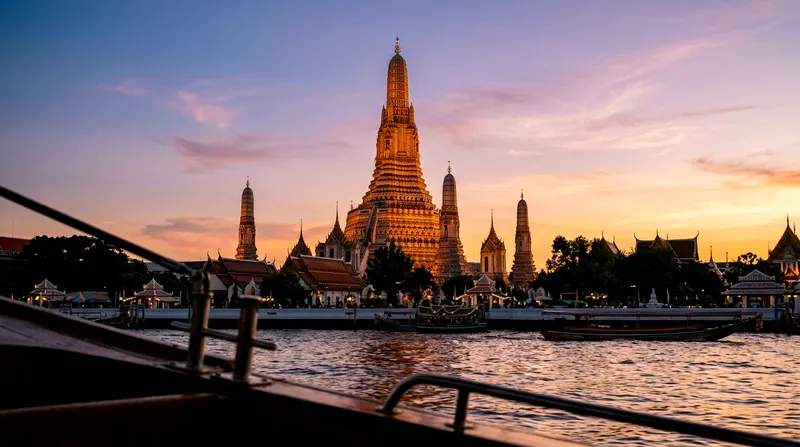
Self-guided wins decisively on flexibility. Want to sit by the Chao Phraya River for twenty minutes watching longtail boats before climbing Wat Arun's steep central steps? You can. Want to skip the Grand Palace's crowded main hall and spend more time in the quieter outer courtyards? Also fine. Group tours can't accommodate this without annoying ten other people. The trade-off is that flexibility requires you to already know what's worth lingering over — which, again, circles back to whether you've done any reading beforehand.
Who Should Choose Which Approach
Neither format suits every traveler, and matching your trip style to the right one matters more than any price difference.
Best for guided tours
First-time visitors with only one day in Bangkok, families with children who benefit from a guide managing logistics and pointing out kid-friendly details, senior travelers who'd rather not navigate MRT transfers or long walks in heat, and anyone intimidated by the Grand Palace's notoriously strict dress code enforcement — guides generally warn you in advance and sometimes carry spare sarongs for rent. If you're coming from a cruise stop or a short layover and need the highlights compressed into a guaranteed window, a tour removes the risk of wasted time entirely.
Best for self-guided
Solo travelers and couples with a full day or more, budget-conscious backpackers who'd rather spend the savings on a Chao Phraya dinner cruise or a day trip to Ayutthaya, and repeat visitors to Bangkok who've already done the orientation tour once and want to explore at their own pace. If you're comfortable reading a map, tolerant of some trial-and-error, and not pressed for time, self-guided genuinely delivers a better experience per baht — not just a cheaper one.
Hybrid Strategy: Best of Both Worlds
The option most comparison pages skip is the one many experienced Bangkok visitors actually use: book a short guided tour or hire a private guide for just the Grand Palace and Wat Phra Kaew — where the history is dense and the dress code enforcement is strictest — then handle Wat Pho and Wat Arun self-guided afterward by ferry.
This splits the cost meaningfully. You pay for expertise only where it earns its keep, then explore the river temples at your own pace in the cooler late afternoon, when the light for photographing Wat Arun's porcelain-covered prang is better anyway. It also solves the dress-code problem efficiently: wear compliant clothing (covered shoulders and knees, no flip-flops at the inner sanctums) for the whole day rather than renting a sarong mid-visit.
Compare this to how travelers approach Chiang Mai, where temples like Wat Phra That Doi Suthep are often done via group tour because the mountain access makes self-guided transport harder, or Ayutthaya, where renting a bicycle to self-guide between ruin sites is standard practice precisely because there's no comparable public transit. Bangkok's temple cluster is unusual in Southeast Asia for being genuinely walkable and transit-connected, which is exactly why self-guided is more viable here than in, say, Krabi or Phuket, where temple sites are scattered and car hire becomes necessary regardless.
Frequently asked questions
Is a guided temple tour worth it in Bangkok?
It's worth it specifically for the Grand Palace and Wat Phra Kaew, where the history is layered and easy to miss without context. It's less essential at Wat Pho and Wat Arun, where the sites are visually self-explanatory and self-guided visitors save money without losing much.
Can I self-guide Bangkok temples using public transport?
Yes. MRT to Sanam Chai station reaches the Grand Palace directly, and the Chao Phraya Express boat or cross-river ferries connect Wat Pho's Tha Tien pier to Wat Arun in a few minutes for a few baht. No private transport or tour booking is required for any of the three main sites.
What's the cost difference between guided and self-guided temple visits?
Guided half-day tours bundle entry, transport, and guiding into one fee that's typically several times higher than the self-guided total of entry tickets plus transit fares. The exact gap varies by operator and season, so compare current tour prices against standalone entry fees before deciding.
How long does it take to visit multiple temples independently?
Budget 5-6 hours to cover the Grand Palace, Wat Phra Kaew, Wat Pho, and Wat Arun self-guided, starting by 8:30am to beat both heat and crowds. Arriving after 11am often stretches the day to 7+ hours due to longer queues.
Should I book a tour in advance or on arrival?
Book at least a day ahead through a platform like Viator or GetYourGuide, or via your hotel, especially in high season (November to February) when popular morning slots fill first. Walk-up booking is possible but limits you to whatever's left, often afternoon slots with worse heat and crowds.